
2.2 The Zeroth Law#
The zeroth law states that if two thermodynamic systems are in thermal equilibrium with each other and separately in thermal equilibrium with a third system, then the three systems are in thermal equilibrium with each other.
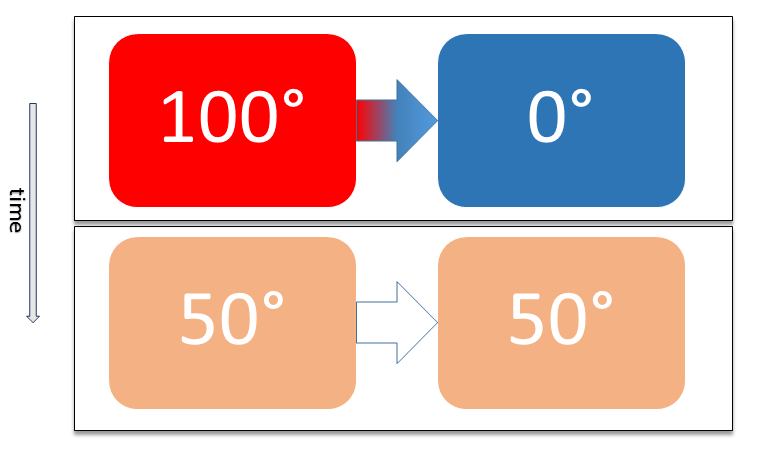
Fig. 28 Development of a thermal equilibrium in a closed system over time through heat flow removing temperature differences. Image source: Thermal equilibrium - Wikipedia#
Two systems are said to be in thermal equilibrium if they are linked by a wall permeable only to heat and do not change over time (Fig. 28). This property is applied in a basic thermometer. When a thermometer is placed in a room or on a body, the temperature reading on the thermometer changes until thermal equilibrium is established between the thermometer and the surrounding system.

Fig. 29 Mercury thermometer (mercury-in-glass thermometer) is used to measure room temperature. Image source: Thermometer - Wikipedia#
Systems in thermodynamic equilibrium are always in thermal equilibrium, but the converse is not always true. If the connection between the systems allows energy transfer as a ‘change in internal energy’ but does not allow the transfer of matter or energy as work, the two systems may reach thermal equilibrium without reaching thermodynamic equilibrium. In thermodynamic equilibrium, no net macroscopic flows of matter or energy within or between systems exist. No macroscopic change occurs in a system in its state of internal thermodynamic equilibrium.