
5.3 Electron Activity, \(pe\)#
Defining \(pe\)#
Aqueous solutions do not contain free protons (\(\ce{H+}\)) and free electrons (\(\ce{e-}\)), but it is nevertheless possible to define relative and activities. The \(p\ce{H}\) (\(=-\log\{\ce{H+}\}\)), measures the relative abundance of protons. Similarly, we can define an equally convenient parameter for the redox intensity \(pe\) (\(=-\log\{e^-\}\)). \(pe\) gives the (hypothetical) electron activity at equilibrium and measures the relative tendency of a solution to accept or transfer electrons. In a highly reducing solution, the tendency to donate electrons, that is, electron activity, is relatively large. Just as the activity of protons is very low at high \(p\ce{H}\), the activity of electrons is very low at high \(pe\). Thus, a high \(pe\) indicates a relatively high tendency for oxidation. In equilibrium equations, \(\ce{H+}\) and \(\ce{e-}\) are treated in an analogous way.
All redox reactions, including half-reactions, follow the same principles of thermodynamics (e.g., spontaneity, etc.) and can be described using chemical equilibrium principles (e.g., the law of mass action, Le Châtelier’s principle, etc.) Using these equilibrium principles allows us to explore oxidation and reduction problems effectively.
Example: What is \(pe\)?
Consider the \(\ce{Fe}\) reduction half-reaction as shown below:
Note that this reaction has an equilibrium constant, \(K\). Using the law of mass action, we can write the equilibrium expression as
\[ K = \frac{\{\ce{Fe^2+}\}}{\{\ce{Fe^3+}\}\{e^-\}} \]Rearrange equilibrium expression,
\[ \{e^-\} = \left[ \frac{1}{K}\frac{\{\ce{Fe^2+}\}}{\{\ce{Fe^3+}\}} \right]\]Apply \(-\log_{10}\) on both sides,
\[ -\log \{e^-\} = p\text{e} = \left[ \log K - \log \frac{\{\ce{Fe^2+}\}}{\{\ce{Fe^3+}\}} \right] \]
Example: What does the \(pe\) value signify?
Let’s explore what the \(pe\) value represents using the \(\ce{Fe}\) reduction example.
Based on our understanding of chemical equilibrium principles, when \(\ce{e-}\) activity is lowered (\(pe\) value is high), the above reaction shifts to the left. That is, the conditions lead to a more oxidized form of \(\ce{Fe}\) (\(\ce{Fe^3+}\)). Therefore, high \(pe\) values imply strong oxidizing conditions.
When \(\ce{e-}\) activity increases (\(pe\) value is low), the above reaction shifts to the right, leading to the reduced form of \(\ce{Fe}\) (\(\ce{Fe^2+}\)). Therefore, low \(pe\) values imply strong reducing conditions.
Example: Calculating \(pe\) in \(\ce{Fe}\) system
Let’s calculate \(pe\) in the above \(\ce{Fe}\) system, if \(\ce{Fe^3+} = \pu{e-5 M}\), \(\ce{Fe^2+} = \pu{e-3 M}\), & \(K=\pu{e13}\)
Substitute known data in the \(K\) expression:
\[\begin{split}\begin{align} \{e^-\} &= \left[ \frac{1}{K}\frac{\{\ce{Fe^2+}\}}{\{\ce{Fe^3+}\}} \right] = \frac{1}{\pu{e13}}\frac{\pu{e-3}}{\pu{e-5}} = \pu{e-11}\\ \therefore pe &= 11 \end{align}\end{split}\]
Example: Calculating \(pe\) in \(\ce{Mn}\) system
Pyrolusite \(\ce{MnO2 (s)}\) reduces in the environment as shown in the half-reaction below:
Let’s write the \(K\) expression for this reaction.
\[K = \frac{ \{\ce{Mn^2+}\} \{\ce{H2O(l)}\}^2}{\{\ce{MnO2(s)}\}\{\ce{H+}\}^4 \{e^-\}^2} \]Per chemical equilibrium “rules,” activities of pure solids and liquids are equal to \(1\). Therefore, \(\{\ce{MnO2(s)}\} = \{\ce{H2O(l)}\} = 1\). The \(K\) expression can be simplified and rearranged as
\[\begin{split}\begin{align} K &= \frac{\{\ce{Mn^2+}\}}{\{\ce{H+}\}^4 \{e^-\}^2}\\ \{e^-\}^2 &= \left[\frac{1}{K} \frac{\{\ce{Mn^2+}\}}{\{\ce{H+}\}^4} \right] \\ \text{Apply}\ -\log_{10}\ \text{on both sides}\\ pe &= \frac{1}{2} \left[ \log K - \log \{\ce{Mn^2+}\} -4p\ce{H} \right] \end{align}\end{split}\]If the unknown values (e.g., \(\{\ce{Mn^2+}\}\), \(p\ce{H}\), and \(K\)) are given in the above system, \(pe\) can be determined.
\(pe\) and \(p\ce{H}\) relationships#
Two components - protons (\(\ce{H+}\)) and electrons (\(\ce{e-}\)) - are omnipresent in the natural aqueous environments. In many half-reactions, both \(\ce{H+}\) and \(\ce{e-}\) participate to facilitate the redox transformation. Consider the reduction of hematite (\(\ce{Fe2O3(s)}\)) mineral into \(\ce{Fe^2+(aq)}\) during weathering reactions. The balanced half-reaction can be shown as follows:
The \(pe\) expression for the above reaction can be derived from the equilibrium expression (rearrange the \(\{\ce{e-}\}\) and apply \(-\log_{10}\)) to arrive at the following equation:
It can be seen from this expression that \(pe\) is related to \(p\ce{H}\).
Redox Potential, \(Eh\)#
Redox half-reactions explicitly involve \(\ce{e-}\), and the law of mass action expressions shows that all participants’ activities and/or concentrations in those reactions are determinable. However, concentrations or activities of the \(\ce{e-}\) are not measurable directly. Like \(\ce{H+}\) transfer in acid-base reactions is measured using a \(p\ce{H}\)-probe, the transfer of \(\ce{e-}\) between two atoms can be quantified by measuring the electrical potential between two electrodes. This electrical potential that indirectly quantifies the \(\ce{e-}\) activity is called redox potential, \(Eh\), and reported in millivolts (\(\pu{mV}\)) or volts (\(\pu{V}\)). The transfer of electrons can be visualized using the operation of a galvanic cell, as shown in Fig. 44.

Fig. 44 A galvanic cell that shows the transfer of \(\ce{e-}\) from \(\ce{Zn}\) to \(\ce{Cu}\). The transfer of the \(\ce{e-}\) is quantified by the voltage meter on the wire. Image source: Galvanic cell - Wikipedia#
The \(Eh\) is correlated to \(pe\) as follows:
Where, \(R = \pu{8.314e-3 kJ mol-1 K-1}\), \(T\) is temperature in \(\pu{K}\), and \(F\) is Faraday’s constant and is equal to \(\pu{96489 C mol−1}\) or \(\pu{96.42 kJ g−1}\). At \(\pu{25 ^\circ C}\), Eq. (57), is simplified to:
\(Eh-p\ce{H}\) or Pourbaix Diagrams#
The environmental conditions, including \(p\ce{H}\) and \(Eh\), can strongly influence the predominance of any redox-sensitive element. Relationships between redox species of different elements vary as a function of \(p\ce{H}\) and \(Eh\) conditions; a diagram that depicts these relationships can help show the likelihood of a particular form of a redox-sensitive element under any given condition. The value of \(Eh-p\ce{H}\) diagrams consists primarily of providing an aid for the interpretation of equilibrium data by permitting the simultaneous representation of many reactions.
Natural waters are often highly dynamic concerning redox status rather than in or near equilibrium. Most redox reactions are slower than acid-base reactions, especially without suitable biochemical conditions. However, these diagrams can greatly aid in understanding the possible redox patterns in natural water systems. In Fig. 45, different \(p\ce{H}\) and \(Eh\) environments are represented. Positive \(Eh\) values represent oxidizing conditions, while negative \(Eh\) values represent reducing conditions. The possible limits of \(Eh\) in natural environments are shown in Fig. 45.

Fig. 45 \(Eh\) and \(p\ce{H}\) conditions for natural waters on Earth’s surface at \(\pu{25 ^\circ C}\). The upper and lower limits represent oxidation or reduction of water to \(\ce{O2(g)}\) or \(\ce{H2(g)}\), respectively. Image source: Pourbaix diagram - Wikipedia#
The upper and lower limits of the \(Eh-p\ce{H}\) diagram are represented by the oxidation and reduction of water to \(\ce{O2(g)}\) and \(\ce{H2(g)}\), respectively, as shown in the table below:
Redox |
Reaction |
\(K\) values |
|---|---|---|
Oxidation |
\(\ce{O2(g) + 4 H+(aq) + 4 e- -> 2 H2O (l)}\) |
\(10^{83.1}\) |
Reduction |
\(\ce{2 H+(aq) + 2 e- -> H2(g)}\) |
\(1\) |
Example: Pourbaix diagram for \(\ce{As}\)
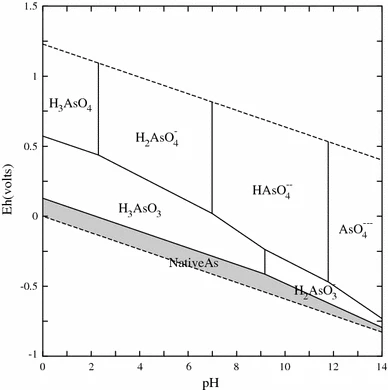
The arsenic problem in the Bengal basin is caused by the redox transformation of multiple \(\ce{As}\) species in soil and groundwater environments. The most common reactions are listed below:
Reaction |
\(K\) values |
|---|---|
\(\ce{H3AsO4 -> H2AsO4- + H+ } \) |
\(10^{-2.3}\) |
\(\ce{H3AsO4 -> HAsO4^2- + 2 H+ } \) |
\(10^{-9.46}\) |
\(\ce{H3AsO4 -> AsO4^3- + 3 H+ } \) |
\(10^{-21.1}\) |
\(\ce{H3AsO4 + 2 H+ + 2 e- -> H3AsO3 + H2O } \) |
\(10^{19.35}\) |
\(\ce{H3AsO3 -> H2AsO3- + H+ } \) |
\(10^{-9.15}\) |
\(\ce{H3AsO3 -> HAsO3^2- + 2 H+ } \) |
\(10^{-23.9}\) |
\(\ce{H3AsO3 -> AsO3^3- + 3 H+ } \) |
\(10^{-39.6}\) |
The resulting Pourbaix diagram is shown in the figure below. Suppose we know the redox conditions prevalent in the soil and groundwater environments. In that case, we can easily read from the diagram what \(\ce{As}\) form is likely to predominate under those conditions.
Image source: Arsenic \( Eh–p\ce{H}\) diagrams at \(\pu{25^\circ C}\) and \(\pu{1 bar}\)
Microorganisms and Redox Reactions#
Redox reactions can be spontaneous, as written. However, these reactions occur at a slow rate. Often, microorganisms play an essential role as catalysts in these reactions. These microorganisms can manufacture or decompose organic matter, produce or consume oxygen, and oxidize or reduce sulfur, iron, nitrogen, and other substances. They may also influence the rate of a geochemical reaction in which they are producers or consumers of the reactants or products. Likely, microorganisms contributed significantly to forming many mineral deposits in Earth’s near-surface environments.
Consider the following reaction in which \(\ce{N}\) is being oxidized:
\(\Delta _{rxn}G^\circ = \pu{-266.5 kJ mol-1}\) for this reaction; therefore, this reaction is spontaneous and favored to occur as written. However, \(\ce{NH4+}\) is very stable in the environment, and the above reaction occurs slowly. This reaction can proceed faster if the aqueous system contains a certain type of bacteria, Nitrosomonas sp. and Nitrobacter sp. These bacteria use \(\ce{NH4+}\) as a nutrient during their metabolism while facilitating the redox reaction. Many such reactions occur in nature.
Note that microorganisms act as catalysts and do not participate in the reactions.