
8.1 What are organic chemicals?#
Formulas#
Because of the complex nature of organic chemicals, a system has been adopted to name these chemicals. The standard nomenclature is developed and maintained by the IUPAC | International Union of Pure and Applied Chemistry.
Molecular formulas of organic chemicals give the numbers of each type of atom in the molecule. For example, the molecular formulas for methane, ethane, and pentane are \(\ce{CH4}\), \(\ce{C2H6}\), and \(\ce{C5H12}\), respectively.
Structural formulas show the orientation of the atoms in a molecule in either two or three dimensions. Condensed structural formulas are used to save space and are written in carbon units. Carbon chains are usually drawn as straight lines in Lewis structures, but Lewis structures are not intended to indicate the geometry of molecules.
Fig. 57 Lewis structures, ball-and-stick models, and space-filling models for methane, ethane, and pentane hydrocarbon molecules.#
Image source: 21.1 Hydrocarbons - Chemistry: Atoms First 2e | OpenStax
A standard method to simplify the drawings of larger molecules is to use a skeletal structure (also called a line-angle structure). In this structure, carbon atoms are not symbolized with a \(\ce{C}\) but are represented by each end of a line or bend in a line. Hydrogen atoms are not drawn if they are attached to a carbon. Other atoms besides carbon and hydrogen are represented by their elemental symbols.
Fig. 58 The same structure can be represented in three different ways: an expanded formula, a condensed formula, and a skeletal structure.#
Image source: 21.1 Hydrocarbons - Chemistry: Atoms First 2e | OpenStax
The three-dimensional geometry of an organic molecule is important because it partly determines its properties.
Isomers are compounds with the same molecular formula but different structural formulas. Hydrocarbons with the same formula, including alkanes, can have different structures. For example, two alkanes have the formula \(\ce{C4H10}\): They are called n-butane and 2-methylpropane (or isobutane) and have the following Lewis structures:
Fig. 59 Isomers for an alkane with the same condensed formula: \(\ce{C4H10}\).#
Image source: 21.1 Hydrocarbons - Chemistry: Atoms First 2e | OpenStax
The compounds n-butane and 2-methylpropane are structural isomers (the term constitutional isomers is also commonly used). Constitutional isomers have the same molecular formula but different spatial arrangements of the atoms in their molecules. The n-butane molecule contains an unbranched chain, meaning no carbon atom is bonded to more than two other carbon atoms. We use the term normal, or the prefix n, to refer to a chain of carbon atoms without branching. The compound 2–methylpropane has a branched chain (the carbon atom in the center of the Lewis structure is bonded to three other carbon atoms)
Hydrocarbons#
The simplest organic compounds are primarily composed of carbon and hydrogen atoms and are called hydrocarbons. Other elements, e.g., oxygen, nitrogen, sulfur, phosphorous, and halogens, may also occur in organic compounds. The fundamental building block of organic compounds is the carbon-carbon bond. The bonding between carbon atoms is covalent. Single bonds (\(\ce{C-C}\)) are formed when one pair of electrons is shared between two carbon atoms. Double bonds (\(\ce{C=C}\)) involve the sharing of two pairs of electrons, and triple bonds (\(\ce{C#C}\)) involve the sharing of three pairs of electrons.
The compound is called an unsaturated organic compound when multiple bonds occur between carbon atoms. The compound is saturated if only single bonds exist between the carbon atoms. These compounds are saturated with \(\ce{H}\)-atoms.
The carbon atoms are joined to form chains, branched structures, or rings. A functional group is an atom or a group of atoms that can be attached to the carbon atoms. In most cases, a functional group contains at least one non-carbon atom. Also important is the order in which the functional groups are attached and the geometric position of the attached groups. All of this variability means that the naming of organic molecules is not an easy task.
Hydrocarbons contain only carbon and hydrogen and are the most common group of organic compounds. The major types of hydrocarbons are alkanes, alkenes, alkynes, and aromatic (or aryl) compounds.
Alkanes are the simplest of the hydrocarbons and have the chemical formula, \(\ce{C_{n}H_{2n+2}}\). In alkanes, the \(\ce{C}\) atoms have single bonds and occur as straight or branched chains and rings. Because of their strong single-carbon bond, alkanes are chemically nonreactive except at high temperatures, such as those found during combustion. Alkanes can undergo substitution reactions in which atoms of another element replace one or more hydrogens.
Alkenes have a double bond between two carbons, and alkynes have a triple bond between two carbons. The type of bonding, single versus multiple, affects the molecule’s reactivity.
Functional groups are distinct structural units in organic compounds characterized by specific bonding arrangements of certain atoms. The types of functional groups in an organic molecule are significant determinants of its chemical properties and are used to classify organic compounds, as outlined in the subsections below.
Alcohols#
Alcohols are derivatives of hydrocarbons in which an \(\ce{–OH}\) group has replaced a hydrogen atom. Although all alcohols have one or more hydroxyl (\(\ce{–OH}\)) functional groups, they do not behave like bases such as \(\ce{NaOH}\) and \(\ce{KOH}\), which are ionic compounds that contain \(\ce{OH-}\) ions. Alcohols are covalent molecules; the \(\ce{–OH}\) group in an alcohol molecule is attached to a carbon atom by a covalent bond.
Ethanol, \(\ce{CH3CH2OH}\) (or \(\ce{C2H5OH}\)), also called ethyl alcohol, is a significant alcohol for human uses. Ethanol is the alcohol some yeast species produce in wine, beer, and distilled drinks. It has long been prepared by humans harnessing the metabolic efforts of yeasts in fermenting various sugars:
The name of alcohol comes from the hydrocarbon from which it was derived. The final -e in the name of the hydrocarbon is replaced by -ol, and the carbon atom to which the \(\ce{–OH}\) group is bonded is indicated by a number placed before the name.
Ethers#
Ethers are compounds that contain the functional group \(\ce{–O–}\). Ethers do not have a designated suffix like the other types of molecules we have named. In the IUPAC system, the oxygen atom and the smaller carbon branch are named an alkoxy substituent, and the remainder of the molecule is the base chain, as in alkanes. As shown in the following compound, the red symbols represent the smaller alkyl group and the oxygen atom, which would be named “methoxy.” The larger carbon branch would be ethane, making the molecule methoxyethane. Many ethers are referred to with common names instead of the IUPAC system names. For common names, the two branches connected to the oxygen atom are named separately and followed by “ether.” The common name for the compound shown below is ethylmethyl ether:
Aldehydes and Ketones#
Both aldehydes and ketones contain a carbonyl group, a functional group with a carbon-oxygen double bond. The names for aldehyde and ketone compounds are derived using similar nomenclature rules as for alkanes and alcohols and include the class-identifying suffixes -al and -one, respectively:
In an aldehyde, the carbonyl group is bonded to at least one hydrogen atom. In a ketone, the carbonyl group is bonded to two carbon atoms:
As text, an aldehyde group is represented as \(\ce{–CHO}\); a ketone is represented as \(\ce{–C(O)–}\) or \(\ce{–CO–}\).
Carboxylic Acids and Esters#
The odor of vinegar is caused by the presence of acetic acid, a carboxylic acid, in the vinegar. The odor of ripe bananas and many other fruits is due to the presence of esters, compounds that can be prepared by the reaction of a carboxylic acid with an alcohol. Because esters do not have hydrogen bonds between molecules, they have lower vapor pressures than the alcohols and carboxylic acids from which they are derived.
Fig. 60 Esters are responsible for the odors associated with various plants and their fruits.#
Both carboxylic acids and esters contain a carbonyl group with a second oxygen atom bonded to the carbon atom in the carbonyl group by a single bond. The second oxygen atom also bonds to a hydrogen atom in a carboxylic acid. In an ester, the second oxygen atom bonds to another carbon atom. The names for carboxylic acids and esters include prefixes that denote the lengths of the carbon chains in the molecules and are derived following nomenclature rules similar to those for inorganic acids and salts (see these examples):
The functional groups for an acid and an ester are red in these formulas.
Carboxylic acids are weak acids, meaning they are not 100% ionized in water. Generally, only about 1% of carboxylic acid molecules dissolved in water are ionized at any given time. The remaining molecules are undissociated in the solution.
The simplest carboxylic acid is formic acid, \(\ce{HCOOH}\). Acetic acid, \(\ce{CH3COOH}\), constitutes 3–6% vinegar.
Amines#
Amines are molecules that contain carbon-nitrogen bonds. The nitrogen atom in an amine has a lone pair of electrons and three bonds to other atoms, either carbon or hydrogen. Various nomenclatures are used to derive names for amines, but all involve the class-identifying suffix –ine as illustrated here for a few simple examples:
Cyclic & Aromatic Hydrocarbons#
Cyclic hydrocarbons are hydrocarbons that have a ring structure. The simplest cyclic hydrocarbon is cyclohexane, which has a six-membered ring. Cyclic hydrocarbons can be saturated or unsaturated. Saturated cyclic hydrocarbons have only single bonds between the carbon atoms, while unsaturated cyclic hydrocarbons have one or more double or triple bonds.
Aromatic hydrocarbons are a type of cyclic hydrocarbon that has a special stability due to the delocalization of electrons in the ring. The simplest aromatic hydrocarbon is benzene, which has a six-membered ring with alternating single and double bonds.
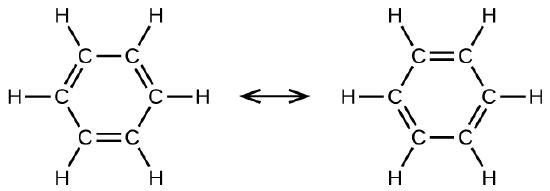
Fig. 61 2D model of a benzene molecule. The carbon “ring” is what makes benzene “aromatic.”#
Cyclic and aromatic hydrocarbons are important in organic chemistry. They are used as solvents, fuels, and building blocks for other chemicals. Some cyclic and aromatic hydrocarbons are also toxic and carcinogenic.
Polynuclear Aromatic Hydrocarbons#
Polynuclear aromatic hydrocarbons (PAHs) are a group of organic compounds formed during the incomplete combustion of organic materials such as coal, oil, and gas. They are also found in cigarette smoke, grilled or charred food, and other sources. PAHs are known to be carcinogenic and can cause other health problems. They also harm the environment and can accumulate in soil and water.
PAHs are composed of multiple aromatic hydrocarbon (benzene-like) rings. The simplest representative is naphthalene, having two aromatic rings and the three-ring compounds anthracene and phenanthrene. They are uncharged, non-polar, and planar. Many are colorless.
PAHs can be harmful to human health. They can cause cancer, birth defects, and other health problems. Exposure to PAHs can occur through the air, water, food, and soil. The Environmental Protection Agency (EPA) has set limits on the amount of PAHs in drinking water.
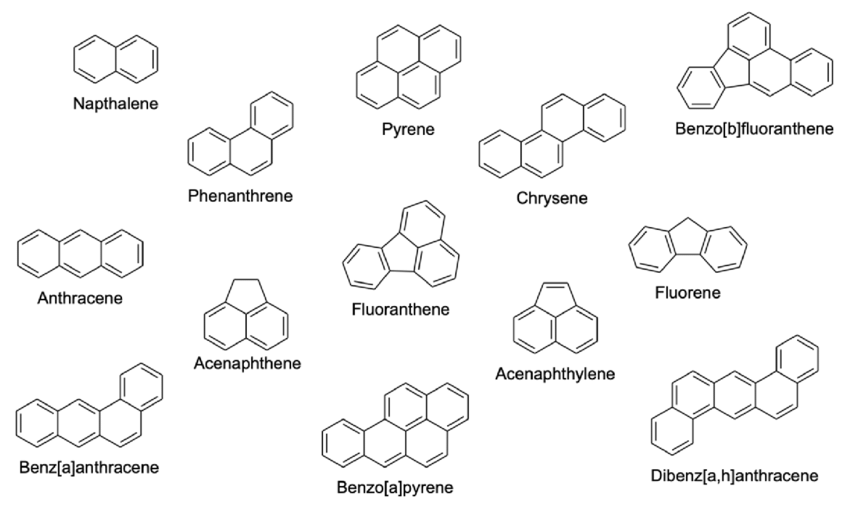
Fig. 62 Structure of some PAHs that have been identified as being carcinogenic.#

Fig. 63 Structure of a complex polynuclear aromatic hydrocarbon. Many benzene rings are fused (polynuclear) to form the hexabenzocoronene molecule. Image source: Polycyclic aromatic hydrocarbon - Wikipedia#